Are you ready to customize your product?
Fill in your information and requirements, and we will address your inquiry promptly!
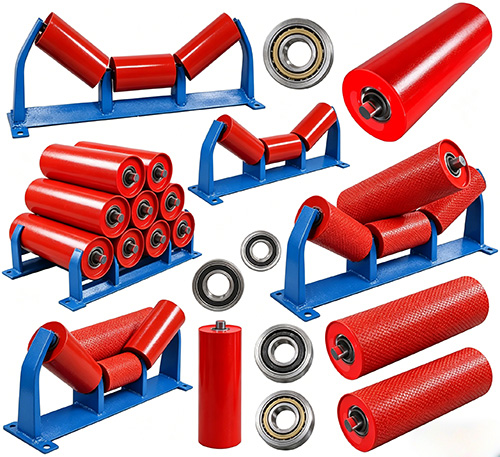
When people think about conveyor performance, they usually focus on motors, belts, or rollers. But in real industrial systems, there is one structural component that quietly determines whether the entire conveyor runs smoothly or constantly struggles with vibration, misalignment, and premature wear: the carrying idler frame.
This component does not move material, and it does not generate power. Yet it is the structural foundation that holds carrying idlers in place and defines the geometry of the belt’s carrying side. If the frame is unstable, even the highest-quality rollers cannot perform properly.
In this article, you will learn how carrying idler frames affect conveyor stability, how they are engineered, where failures typically occur, and how you can optimize your system design for long-term reliability.
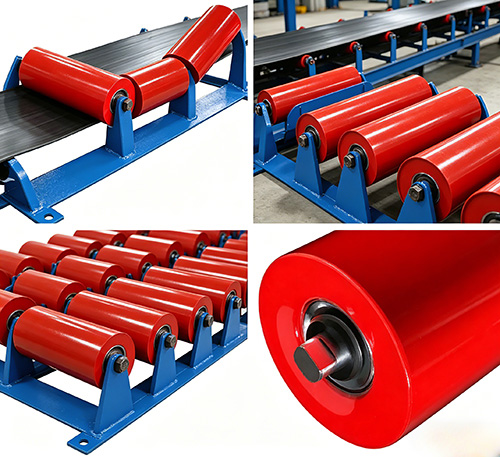
A conveyor belt does not float freely—it is fully dependent on the structural alignment of its supporting frames. The carrying idler frame defines:
Even a small deviation in frame alignment can lead to long-term operational issues such as uneven belt wear, material spillage, and increased maintenance frequency.
Industry maintenance observations show that structural misalignment is one of the leading hidden causes of conveyor inefficiency, often mistaken for roller or belt failure.
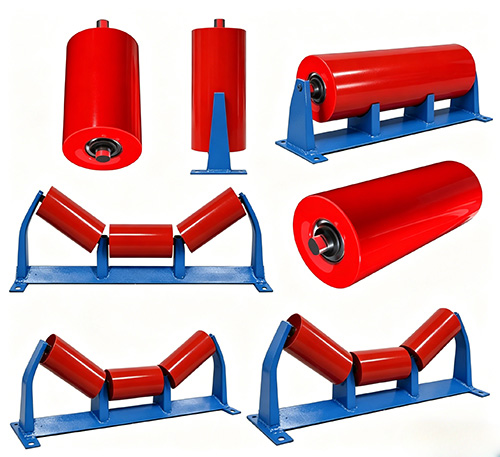
A carrying idler frame is designed to hold multiple rollers (typically troughing rollers) in a fixed geometric arrangement. This creates a stable support system for the loaded side of the conveyor belt.
Its main functions include:
Unlike dynamic components, the frame is a static but load-bearing structure. Its precision determines how effectively the conveyor distributes weight across rollers.
Many operators underestimate how much the frame geometry affects system behavior. In practice, three key design factors determine performance:
The trough angle determines how material is centered on the belt. Incorrect angles can lead to spillage or uneven load distribution.
A weak frame structure will flex under load, causing roller misalignment and belt instability.
Even a perfectly manufactured frame will fail if installed incorrectly. Small deviations accumulate over long conveyor distances.
Used in light-duty applications where minimal troughing is required.
The most common design, supporting three or more rollers to form a trough shape.
Installed in loading zones where heavy material drop occurs.
Allows modification of trough angle or roller positioning for specialized applications.
| Frame Type | Function Area | Strength Level | Best Application |
|---|---|---|---|
| Flat Frame | Return or light load | Low | Short conveyors |
| Troughing Frame | Material carrying zone | Medium-High | General industry |
| Impact Frame | Loading zones | High | Heavy material drop |
| Adjustable Frame | Flexible configurations | Medium | Custom systems |
Most conveyor issues linked to frames are not caused by visible damage but by subtle structural deviations.
Even a few millimeters of deviation can cause belt tracking issues over long distances.
If one side of the frame is slightly lower, rollers will not share load evenly.
Poor fabrication precision leads to long-term instability.
In large systems, ground movement can gradually distort frame alignment.
A bulk material handling system experienced continuous belt wandering and uneven wear patterns. Operators initially replaced rollers multiple times, assuming the issue was mechanical wear.
After inspection, engineers discovered that the carrying idler frames were not aligned consistently across sections of the conveyor line.
This demonstrates that structural correction is often more effective than component replacement.
A well-designed frame system contributes to:
According to conveyor design principles referenced by organizations such as the CEMA, structural alignment is one of the most critical factors in conveyor reliability.
Use precise leveling tools to ensure consistent height across all frame sections.
Ensure all frames maintain identical troughing geometry.
Prevent vibration and movement during operation.
Check for deformation or welding fatigue over time.
Carrying idler frames work as part of a larger system:
Together, these components create a balanced conveyor architecture that ensures long-term stability.
Modern conveyor systems are evolving toward:
Despite these innovations, the fundamental role of the carrying idler frame remains unchanged: maintaining structural integrity.
Carrying idler frames are often overlooked, but they are one of the most important structural components in any conveyor system. They define alignment, stability, and load distribution—factors that directly impact system efficiency and maintenance costs.
When properly designed, installed, and maintained, carrying idler frames significantly improve conveyor reliability and ensure long-term operational stability.
What is a carrying idler frame used for?
It supports and positions carrying idlers to maintain conveyor belt stability.
What causes carrying idler frame failure?
Common causes include misalignment, poor installation, and structural fatigue.
How often should frames be inspected?
Regular inspections are recommended to detect early deformation or misalignment.
Can frame alignment affect belt tracking?
Yes, improper alignment is one of the main causes of belt wandering.
Are carrying idler frames suitable for all conveyors?
Yes, they are used in nearly all belt conveyor systems, regardless of industry.