Are you ready to customize your product?
Fill in your information and requirements, and we will address your inquiry promptly!



Roller conveyors are among the most practical ways to move cartons, pallets, panels, containers, work carriers, and other rigid unit loads through manufacturing, warehousing, packaging, and material-handling processes. Their basic construction is easy to understand: a series of rollers is mounted inside a supporting frame so products can move across the conveyor with relatively low rolling resistance. What makes a reliable system more complicated is that every application places different demands on those rollers.
A carton moving through a packing line does not behave like a loaded pallet. A long panel does not place weight on the conveyor in the same way as a compact machine component. Even two products with similar weights may require different roller spacing, conveyor widths, drive systems, and transfer designs because their bottom surfaces and centers of gravity are different.
For this reason, selecting roller conveyors should not begin with one specification such as load capacity or roller diameter. The more useful approach is to understand the product, its supporting surface, the required movement, the process layout, and the way the conveyor will interact with other equipment. When these factors are considered together, roller conveying can become a stable part of the entire production flow rather than simply a transportation section between two machines.
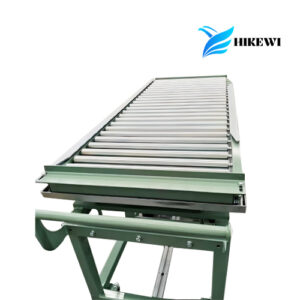
Roller conveyors are material-handling systems that use multiple cylindrical rollers arranged along a frame to support and transport unit loads. Depending on the design, products may move through gravity, manual force, mechanical drive, or individually controlled powered zones.
They are part of the broader family of conveyor systems, which are used to move materials between different locations or process stages. The defining feature of roller conveying is that the transported product normally makes direct contact with a series of rollers rather than resting on a continuous belt.
This makes product geometry extremely important. A carton with a firm, flat bottom can distribute its weight across several rollers. A pallet with continuous runners can also create a stable contact pattern when the roller spacing and travel direction are correctly selected. In contrast, a flexible bag or a product with small feet may not bridge the spaces between rollers reliably.
The word “roller conveyors” also covers several configurations rather than one fixed machine. Gravity conveyors, powered roller conveyors, chain-driven roller systems, accumulation conveyors, straight sections, curved sections, and transfer modules can all be designed around the same basic principle while serving very different operational requirements.
The working principle begins with load support. When a product is placed on the conveyor, its weight is divided among the rollers beneath its supporting surface. Each roller transfers this force through its tube, shaft, bearings, and mounting points into the conveyor frame and supporting structure.
In a gravity conveyor, the rollers rotate freely as the product is pushed manually or moves along a controlled incline. This configuration can work well for straightforward movement between workstations or for temporary accumulation where precise automatic control is not required.
Powered roller conveyors use a drive mechanism to rotate the rollers. Depending on system construction, power may be transferred through chains, belts, shafts, motorized rollers, or other mechanical arrangements. Powered movement allows the system to control product speed, transport loads over longer sections, coordinate with machinery, and reduce dependence on manual pushing.
Modern systems may divide the conveyor into separate zones. Each zone can operate only when a product needs to move, allowing loads to wait at controlled positions and reducing unnecessary contact between accumulated items. The conveyor therefore becomes both a transportation device and part of the process-control system.
Different roller conveyors solve different handling problems. Choosing the correct type is more important than simply selecting the most powerful configuration.
Gravity roller conveyors use freely rotating rollers and are well suited to simple movement where manual force or inclination can provide the required motion. Their mechanical simplicity makes them useful for many workstation, packaging, loading, and short-transfer layouts.
Powered roller conveyors are designed for applications where products must move automatically and consistently. They can maintain controlled conveying speeds, connect production processes, and work with sensors or downstream equipment.
Chain-driven roller conveyors are commonly considered when heavier unit loads or more demanding drive requirements are involved. The mechanical connection between driven rollers provides positive motion, but the system also requires appropriate chain tension, sprocket alignment, guarding, and maintenance access.
Accumulation roller conveyors allow products to queue without moving continuously against one another. They are particularly valuable when upstream production must continue while downstream equipment temporarily stops.
Straight and curved roller sections can also be combined to follow the required line layout. Straight sections provide direct transportation, while curves and transfer mechanisms allow products to change direction without requiring the entire production layout to remain linear.
The following comparison gives a clearer view of where the major configurations fit.
| Roller Conveyor Type | Movement Method | Best Suited For | Main Design Focus |
|---|---|---|---|
| Gravity roller conveyor | Manual force or incline | Simple transfers and workstations | Slope, product control, roller spacing |
| Powered roller conveyor | Motor-driven rollers | Automatic production and handling lines | Speed, drive capacity, controls |
| Chain-driven roller conveyor | Chain and sprocket drive | Heavier rigid unit loads | Torque, chain tension, structural strength |
| Accumulation roller conveyor | Controlled powered zones | Queuing and process synchronization | Sensors, zone length, load spacing |
| Straight roller conveyor | Gravity or powered | Direct point-to-point movement | Width, length, product support |
| Curved roller conveyor | Gravity or powered | Direction changes | Curve geometry and product tracking |
| Transfer roller conveyor | Powered transfer mechanism | Merging or changing flow direction | Timing, transfer gap, support continuity |
No one type is universally preferable. A good selection is the configuration that delivers the required movement without unnecessary mechanical or control complexity.

A product’s underside is one of the first things that should be examined when considering roller conveyors. The conveyor does not support the external dimensions of the product; it supports only the areas that actually touch the rollers.
For cartons and rigid containers, this normally means evaluating the shortest bottom dimension. The product must remain supported while moving from one roller to the next. If the spacing is too large, the leading edge may drop into a gap or the load may rock during movement.
Pallets require closer examination because their undersides can include runners, blocks, openings, and irregular contact areas. Travel orientation can therefore change conveyor performance. A pallet that moves smoothly in one direction may become unstable when rotated because its supporting runners no longer interact with the rollers in the same way.
Long products introduce another consideration. Even if their overall weight is moderate, a long span between supporting areas may result in product deflection. Conversely, a compact but very heavy component may create high localized forces on only a few rollers.
Tall loads should also be evaluated for stability. Products with a high center of gravity react more strongly to sudden acceleration, stopping, and uneven transfers. In such cases, smooth speed changes and carefully aligned conveyor transitions can matter as much as nominal load capacity.
This product-first approach is important because roller conveyors are most effective when the load itself has predictable geometry. If the underside cannot maintain stable support, a carrier, fixture, tray, or alternative conveying surface may be necessary.
Roller spacing, sometimes referred to as roller pitch, determines how many rollers support a product at any point along the conveyor. It directly affects load stability, individual roller loading, and the smoothness of transportation.
When spacing is too wide, products may rock or strike the next roller as they move. In more serious cases, small products or unsupported pallet features may enter the gaps. Excessively wide spacing can also concentrate the load on fewer rollers and increase the force carried by each roller, shaft, and bearing.
A commonly used preliminary concept is that the product should remain supported by multiple rollers throughout its travel. However, treating a fixed number of rollers as a universal design rule would be misleading. Heavy loads, flexible products, unusual pallets, and high-impact applications may require a larger supporting area.
The correct spacing should therefore be derived from product geometry, supporting length, load distribution, travel orientation, roller capacity, and transfer conditions.
Very close spacing is not automatically the best solution either. Every additional roller introduces more bearings, shafts, and rotating components. Powered configurations may also require additional drive connections. Good engineering aims for adequate support without creating unnecessary complexity.
The practical question is not “How close can the rollers be?” but “What roller spacing keeps this specific product stable throughout the complete movement?”
Load capacity is often one of the first specifications considered when comparing roller conveyors, but a total weight figure provides only part of the information needed.
Imagine a product weighing 600 kg that remains supported by six rollers. Under a simplified equal-load assumption, each roller would carry an average of 100 kg. If the same load geometry results in only three rollers providing effective support, the average becomes 200 kg per roller.
Real loads are rarely distributed perfectly. An off-center payload, uneven pallet, manufacturing tolerance, product deformation, conveyor-frame deflection, or surface irregularity can cause some rollers to carry more force than others.
Dynamic operation creates additional requirements. A stationary load mainly produces vertical forces, while a moving load must accelerate and decelerate. When products enter a conveyor, strike a stop, cross a transfer gap, or change direction, temporary forces can exceed those present during steady movement.
Accumulation also needs to be considered. A conveyor section carrying one heavy pallet may operate differently when several pallets stop in the same zone and their combined weight is supported by the frame simultaneously.
For these reasons, conveyor capacity should be evaluated through the complete load path: roller tube, shaft, bearing, frame, support structure, drive system, and transfer components. Increasing only one component does not automatically increase the capacity of the complete conveyor.
Roller construction has a direct influence on conveyor performance. Diameter is important because it affects structural stiffness, available bearing size, rotational characteristics, and resistance to bending.
However, diameter should not be isolated from the rest of the roller assembly. Tube thickness, shaft dimensions, bearing design, conveyor width, and the location of the load all contribute to the forces experienced during operation.
A larger-diameter roller can still perform poorly when connected to an undersized shaft. A strong roller and shaft assembly can also become ineffective if the side frame does not provide adequate support. The roller therefore needs to be treated as one component within the complete structural system.
Roller material should also reflect the application. Mechanical strength, surface durability, product protection, cleanliness, corrosion exposure, and operating environment can all influence material or surface-treatment requirements.
Bearings determine how smoothly the rollers rotate under load. Their suitability depends on load level, speed, operating frequency, alignment, contamination, and maintenance conditions. Poor alignment can create unnecessary bearing forces even when the bearing itself has sufficient nominal capacity.
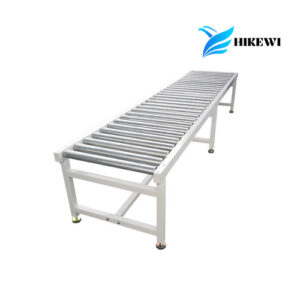
Laienka’s existing Roller Conveyor illustrates the configurable nature of industrial roller equipment, with different roller diameters, roller spacing, operating speeds, conveyor lengths, and capacity ranges available for different handling requirements. These specifications should be matched to the actual product rather than selected independently.
The decision between gravity and powered roller conveyors should begin with the level of movement control required by the process.
Gravity conveyors can provide an efficient solution when products only need to move short distances and operators can control the flow. They can also use a carefully designed slope so gravity provides movement. Because there are fewer powered components, the basic mechanical system can remain relatively straightforward.
However, heavy loads moving downhill require careful speed control. A heavier product carries more momentum, so stops, slope angle, spacing, and operator interaction need to be considered. Gravity should not be interpreted as uncontrolled movement.
Powered roller conveyors become more useful when product flow must be automatic. They can maintain a defined speed, transport loads over horizontal sections, position products at workstations, and coordinate movement with other production equipment.
For automated lines, powered sections may be divided into controlled zones. Sensors determine whether a zone is occupied, and the control system decides when the product can move into the next section. This makes accumulation and process synchronization more manageable.
The best choice therefore depends on the operating sequence. If products move manually between two nearby stations, sophisticated zone control may provide little practical value. If multiple products must automatically queue and enter machines at specific times, gravity movement may not provide enough control.
Roller and belt conveyors are both widely used material-handling solutions, but they interact with products differently.
Roller conveyors provide a series of discrete supporting points. They are particularly effective for products with rigid bottoms that can bridge the space between adjacent rollers. Pallets, cartons, panels, containers, fixtures, and many industrial assemblies fit this handling principle well.
A belt conveyor provides continuous surface contact. This makes it more suitable for products that are too small to span roller gaps, items with flexible bases, loose packages, and products that need more consistent surface support.
Roller systems can also simplify the integration of certain mechanical devices. Stops, pop-up transfers, lifts, and other mechanisms can operate through the spaces between rollers. This makes roller conveyors useful in production layouts where products must change direction or interact with workstations.
Neither conveyor type should be selected solely on the basis of which one appears more robust. Product geometry, weight, speed, transfer requirements, handling orientation, and process integration all influence the decision.
The existing article on roller conveyor systems and material handling efficiency provides additional context on how roller-based systems can connect different stages of industrial material flow.
A roller conveyor rarely exists as one isolated straight section. Real systems may include multiple conveyor lengths, curves, junctions, lifts, pallet stops, transfer units, machines, and workstations.
Every transition creates a potential change in product support. If the gap between two sections is too large, the product may drop slightly before reaching the next roller. Repeated impact at this point can affect both the product and mechanical components.
Height alignment matters for the same reason. Two conveyor sections that appear almost level can still create noticeable impact when rigid heavy loads repeatedly cross the joint.
Conveyor speed should also be coordinated between sections. When a fast upstream conveyor feeds a significantly slower section, products may accumulate unexpectedly or collide. When the downstream conveyor moves much faster, excessive spacing may be created.
Direction changes require additional engineering. Curves need to maintain product orientation while allowing different travel paths across the inner and outer sides of the conveyor. Right-angle transfers may use lifting or chain mechanisms to temporarily support the product while changing its direction.
Good layout design therefore considers the path of the product rather than simply fitting conveyor equipment into the available floor space.
Roller conveyors are well suited to automation because they can create predictable product positions along a defined path.
Sensors can detect whether a product has entered a section, reached a stop, cleared a transfer, or occupied an accumulation zone. A control system can use these signals to coordinate movement with production machines, robots, palletizers, inspection equipment, labeling systems, or other process equipment.
A conveyor may run continuously in a simple application, but more advanced systems can activate only the zones needed for the current product. This allows loads to wait without every roller running continuously.
Automation can also improve positioning. A conveyor might operate at normal transport speed and then reduce speed before a product reaches an inspection or robotic station. More controlled deceleration can reduce impact and improve repeatability.
Mechanical design still determines whether the automation performs well. Sensors cannot eliminate instability created by excessive roller spacing, and software cannot correct a poorly aligned transfer every time a pallet crosses it. Controls should therefore be developed alongside the mechanical layout instead of being added after the conveying system has already been finalized.
Future automation should also be considered during initial equipment planning. Leaving suitable locations for sensors, stops, cabling, guards, control equipment, and transfer mechanisms can make later expansion easier.
Roller conveyors can be used wherever stable unit loads need to move repeatedly between defined operational areas.
In manufacturing environments, they can transport components, fixtures, assemblies, panels, containers, or work carriers between processing stages. The conveyor may connect machining, assembly, inspection, packaging, and robotic handling into one continuous workflow.
Warehousing and logistics operations can use roller systems to connect receiving, storage interfaces, picking or packing areas, accumulation sections, and dispatch processes. Different conveyor types can be combined according to whether products need manual handling, powered movement, or automatic accumulation.
Packaging lines commonly use roller conveyors for cartons, cases, trays, and containers with sufficiently rigid bases. Gravity sections may provide temporary manual accumulation, while powered sections can control product spacing around packaging or inspection equipment.
Pallet handling is another important application. Pallets normally require stronger rollers, suitable drive capacity, adequate frame rigidity, and correct roller spacing based on runner geometry. Transfer points also require particular attention because heavy pallets can generate substantial impact when support changes.
Roller conveyors can therefore serve very different applications, but the engineering principle remains consistent: the load must have a suitable interface with the rollers, and the conveyor must match the required movement.
A relatively simple conveyor design still requires regular inspection if consistent performance is expected over long operating periods.
Rollers should be checked for smooth rotation, unusual noise, visible damage, looseness, or deformation. A roller that develops excessive resistance can increase the force required to move products and may shift additional loading onto adjacent rollers.
Bearings should be inspected according to the application and bearing design. Contamination, alignment errors, repeated shock loading, and unsuitable maintenance practices can gradually increase friction or wear.
Powered conveyors require additional inspection of drive components. Chains, sprockets, belts, couplings, motors, and tensioning systems should remain correctly aligned and adjusted. Excessive tension can introduce unnecessary bearing loads, while insufficient tension may result in inconsistent power transmission.
Frame alignment and structural connections should also be reviewed. Loose fasteners, damaged supports, or changes in conveyor level can influence product tracking and transfer quality.
Cleaning requirements depend on the operating environment. Dust, packaging fragments, chips, residue, and other contaminants may collect between rollers or around drive components. Designing the system with reasonable maintenance access can therefore improve long-term serviceability.
Preventive maintenance is most effective when it is based on actual operating conditions. A conveyor running occasionally with light loads does not experience the same duty cycle as a system transporting heavy loads through repeated starts, stops, and transfers.
A reliable selection process begins by defining the conveyed product. Record its minimum and maximum dimensions, operating weight, underside structure, travel orientation, and center of gravity. If a pallet, tray, carrier, or fixture moves with the product, it should be included in this evaluation.
The next step is determining how the load will contact the rollers. This helps establish the required conveyor width, roller spacing, roller construction, and likely load distribution.
Operating requirements should then be documented. Required conveyor length, working height, speed, throughput, start-stop frequency, accumulation, transfer points, and positioning requirements all influence system configuration.
The drive method can then be chosen according to the process. Gravity movement may be sufficient for simple manual handling, while powered conveyors are more appropriate when controlled automatic flow is needed. Chain-driven or other stronger configurations may be considered for demanding loads.
Layout requirements should also be reviewed before final selection. Straight transportation, curves, merging, diverting, right-angle transfers, machine interfaces, and changes in elevation may require different conveyor sections working together.
Finally, the operating environment and future production plans should be considered. Maintenance access, contamination, cleaning, surrounding machinery, controls, sensors, and potential automation upgrades can all influence the most suitable design.
A useful conveyor specification therefore describes what the products need to do, not simply what conveyor model is required.

The first common mistake is choosing equipment from product weight alone. A load rating does not reveal how the weight is distributed among individual rollers or whether the product underside is suitable for the selected spacing.
Another mistake is treating roller diameter as the main indicator of strength. Roller tubes, shafts, bearings, frames, support spacing, and drive components all contribute to total system capacity.
Ignoring transfer points can also create problems. A conveyor may perform smoothly along its main length but generate impact whenever products cross a poorly designed junction.
Product orientation is sometimes overlooked as well. Changing the direction in which a pallet or container travels can change the supporting contact pattern and therefore alter the number of rollers carrying the load.
Overengineering is another risk. Selecting the heaviest roller, most powerful drive, and closest roller spacing for every application increases mechanical complexity without necessarily improving the actual process. Conveyor design should be proportional to the operating requirement.
Finally, automation should not be considered only after installation. If future sensors, transfer units, pallet stops, robots, or controlled zones are likely, incorporating those possibilities into the original mechanical layout can provide greater flexibility.
Roller conveyors provide a versatile foundation for moving rigid unit loads through manufacturing, warehousing, packaging, pallet handling, and automated production processes. Their mechanical concept is straightforward, but successful application depends on matching the conveyor to the actual behavior of the product.
Product dimensions, underside geometry, weight distribution, roller spacing, roller diameter, drive selection, frame strength, transfer geometry, speed, and automation requirements should all be evaluated as parts of one system. Concentrating on a single specification can easily overlook another factor that limits performance.
The most effective roller conveyor is therefore not automatically the largest, fastest, or strongest configuration. It is the system that keeps the product properly supported, delivers the required movement, integrates smoothly with surrounding processes, and remains practical to inspect and maintain.
By beginning with the product and working outward toward the conveyor layout, you can make more informed decisions about roller type, spacing, drive method, controls, and system structure. That approach creates a stronger foundation for reliable material flow than selecting equipment from catalog specifications alone.
What are roller conveyors used for?
Roller conveyors are used to move rigid unit loads such as cartons, pallets, panels, containers, trays, fixtures, and industrial components. They can connect manufacturing, packaging, warehousing, assembly, inspection, storage, and automated handling processes through gravity or powered movement.
What products are suitable for roller conveyors?
Products should have a sufficiently firm supporting surface to remain stable across several rollers. Cartons, pallets, rigid containers, panels, and carriers are common examples. The underside geometry, dimensions, weight distribution, and travel orientation should be reviewed before roller spacing is selected.
What is the difference between gravity and powered roller conveyors?
Gravity roller conveyors rely on manual force or a controlled incline, while powered systems use a drive mechanism to move products automatically. Powered conveyors provide greater control over speed, positioning, accumulation, and machine integration, while gravity systems can suit simpler handling processes.
How is roller spacing selected for roller conveyors?
Roller spacing depends on the shortest supporting dimension of the product, its bottom geometry, weight distribution, roller capacity, and travel orientation. The load should remain adequately supported as it moves between rollers and crosses conveyor transfers rather than relying on one universal spacing rule.
Can roller conveyors be used in automated production lines?
Yes. Powered roller conveyors can integrate with sensors, PLC controls, accumulation zones, stops, transfers, robots, palletizers, and processing equipment. Reliable automation begins with correct mechanical support, smooth transfers, stable alignment, and a control strategy matched to the required production sequence.