Are you ready to customize your product?
Fill in your information and requirements, and we will address your inquiry promptly!


In modern material handling systems, one of the most persistent challenges is maintaining conveyor belt cleanliness and preventing material buildup along the return and carry sides. While operators often focus on drive systems, rollers, and alignment devices, a surprisingly overlooked component plays a crucial role in solving these issues: comb idlers.
Comb idlers are designed with a unique self-cleaning structure that helps prevent material carryback, reduce belt contamination, and improve overall conveyor efficiency. Unlike standard idlers, they actively interact with the belt surface, scraping off residual material while maintaining smooth belt support.
In this article, you will learn how comb idlers work, where they should be installed, how they improve conveyor performance, and how they compare with traditional idler systems in real industrial environments.
Before understanding comb idlers, you need to understand the issue they solve: material carryback.
In many conveyor systems, especially bulk material handling operations, a portion of the transported material does not fully discharge at the transfer point. Instead, it sticks to the belt surface and returns along the system.
Carryback leads to:
Industry observations in bulk handling environments show that carryback is one of the most common causes of unplanned cleaning shutdowns in conveyor systems.
A comb idler is a specially designed conveyor idler featuring multiple finger-like structures (similar to a comb shape) positioned between rollers.
These “fingers” serve a dual function:
As the belt moves over the comb idler:
Unlike rigid scrapers, comb idlers work passively and continuously without requiring external adjustment.
The comb structure removes material buildup during normal operation, reducing the need for manual cleaning.
By minimizing abrasive material accumulation, comb idlers help extend belt service life.
Cleaner belts operate with lower friction and reduced resistance, improving overall system efficiency.
Less buildup means fewer shutdowns for cleaning and maintenance.
Reducing spillage around the conveyor lowers slip hazards and dust-related risks.
| Feature | Standard Idler | Comb Idler |
|---|---|---|
| Belt Support | Yes | Yes |
| Self-Cleaning Function | No | Yes |
| Material Carryback Reduction | Low | High |
| Maintenance Requirement | Medium | Lower |
| Dust Control | Limited | Improved |
Unlike conventional idlers that only support belt movement, comb idlers actively improve system cleanliness.
Correct installation is essential to maximize performance.
This is the most effective location, where material buildup commonly occurs.
Areas where material is loaded onto the belt often experience residue accumulation.
The longer the system, the more opportunities for carryback buildup.
Systems handling fine powders or granular materials benefit significantly from comb idlers.
A continuous material handling system experienced heavy buildup under the return side of the conveyor. Operators reported frequent shutdowns for cleaning, which disrupted production flow.
Comb idlers were installed at key return zones and after transfer points.
This case demonstrates how a relatively simple mechanical upgrade can solve persistent operational inefficiencies.
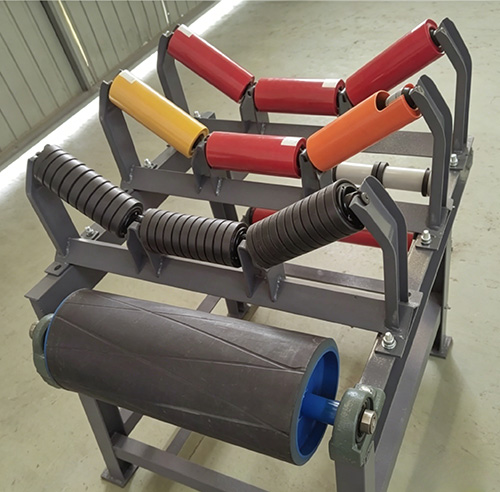
The performance of comb-shaped idler wheels is based on mechanical interaction between belt surface and comb structure:
This passive system requires no electrical power or external control, making it highly reliable.
Comb idlers are widely used in industries where cleanliness and efficiency are critical. Based on operational feedback in material handling systems, they provide:
According to general conveyor design principles referenced by organizations such as the CEMA, controlling carryback is a key factor in improving conveyor reliability and reducing maintenance costs.
Comb idlers perform best when combined with a properly designed conveyor system:
Together, these components create a more stable and efficient conveyor ecosystem.
Installing comb-shaped idler wheels only in low-impact zones reduces their effectiveness.
Highly sticky materials may require additional cleaning systems.
Comb idlers cannot compensate for major structural misalignment.
Although low-maintenance, periodic inspection is still necessary.
To ensure long-term performance:
Proper maintenance ensures consistent self-cleaning performance.
On professional platforms such as LinkedIn, many conveyor engineers emphasize that material carryback is one of the most underestimated operational costs in bulk handling systems.
Modern conveyor design increasingly focuses on integrating passive cleaning components like comb-shaped idler wheels to reduce reliance on manual cleaning processes.
The future of conveyor cleaning systems is moving toward hybrid solutions:
Despite these advancements, comb idlers remain a foundational solution due to their simplicity and reliability.
Comb idlers are a highly effective solution for improving conveyor system cleanliness and efficiency. By reducing material carryback and minimizing buildup, they help lower maintenance requirements and improve overall operational stability.
When properly integrated into a conveyor system, comb idlers contribute to a cleaner, safer, and more efficient material handling process—especially in continuous industrial operations.
What are comb idlers used for?
They are used to reduce material carryback and clean conveyor belts during operation.
Where should comb idlers be installed?
They are most effective on the return side and after material transfer points.
Do comb-shaped idler wheels replace belt cleaners?
No, they complement cleaning systems but do not fully replace them in all applications.
Can comb-shaped idler wheels improve conveyor efficiency?
Yes, by reducing buildup and friction, they help improve system performance.
Are comb-shaped idler wheels suitable for all materials?
They work best with dry and granular materials, while sticky materials may require additional cleaning systems.