Are you ready to customize your product?
Fill in your information and requirements, and we will address your inquiry promptly!


In conveyor systems, most performance problems are not caused by motors or belts themselves but by subtle mechanical issues that develop over time. One of the most overlooked contributors is improper belt support and alignment, especially on the return side of the conveyor.
This is where parallel idlers play a critical role.
Unlike troughing or self-aligning idlers, parallel idler gears are designed with a straight, non-angled roller configuration. Their simplicity makes them essential for stable belt support, particularly in return-side applications where the belt must remain flat, stable, and free from unnecessary stress.
In this article, you will learn how parallel idlers work, why they are essential in conveyor design, where they should be installed, and how they contribute to long-term system efficiency.
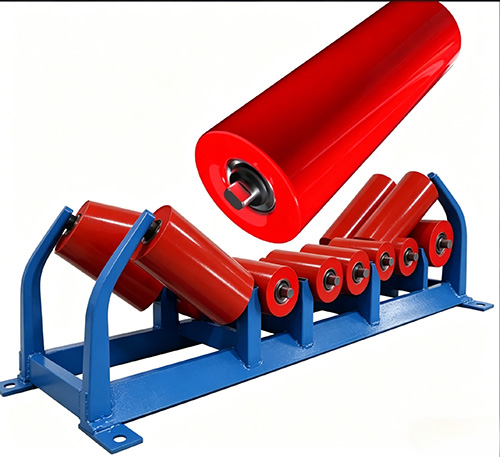
At first glance, parallel idler gears appear to be the simplest component in a conveyor system. However, simplicity does not mean low importance.
In fact, parallel idler gears are responsible for:
Industry maintenance observations show that return-side instability is one of the most common causes of long-term belt wear. Parallel idlers help eliminate this issue by maintaining consistent flat support.
Parallel idlers are straight-roller conveyor components used primarily on the return side of the belt. Unlike troughing idlers, they do not form a V or U shape. Instead, they provide a flat, uniform support surface.
Their working principle is simple:
This simple structure ensures predictable and stable belt behavior.
This is the most common application area. The return belt must remain stable to avoid vibration and misalignment.
In long-distance conveyors, belt sagging becomes more pronounced without proper support.
At higher speeds, even small vibrations can create instability. Parallel idlers help stabilize motion.
When the return belt carries no material, flat support is ideal.
| Feature | Parallel Idlers | Troughing Idlers | Self-Aligning Idlers |
|---|---|---|---|
| Belt Shape | Flat support | V-shaped support | Adjustable alignment |
| Primary Use | Return side | Carrying side | Alignment correction |
| Stability Function | Moderate-High | High load support | Tracking correction |
| Complexity | Low | Medium | High |
| Maintenance Needs | Low | Medium | Medium |
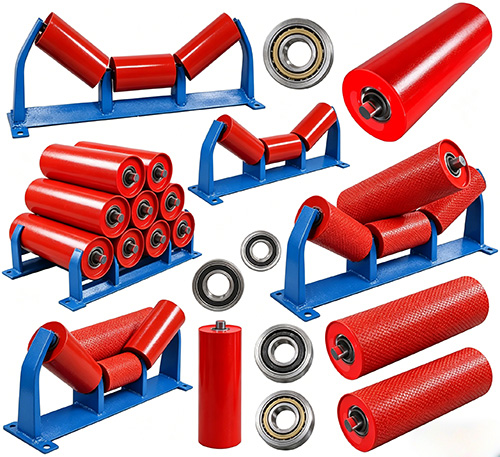
Parallel idlers may seem simple, but their engineering function is critical for system balance.
They help:
In well-designed conveyor systems, return-side stability is just as important as carrying-side performance.
A continuous production conveyor system experienced consistent vibration issues on the return side. Operators noticed increasing noise levels and uneven belt movement during high-speed operation.
The issue was traced to inconsistent support spacing and lack of proper parallel idler configuration.
This demonstrates how even basic structural improvements can deliver measurable performance gains.
Parallel idlers are especially effective in solving:
These issues often develop slowly and are mistaken for motor or belt problems.
Uniform spacing ensures even belt support and prevents sagging.
Even slight frame deviation can reduce idler effectiveness.
Although return belts carry no material, tension imbalance can still occur.
Smooth rotation ensures minimal friction and vibration.
Parallel idlers work best as part of a complete system:
Together, these components create a stable and efficient conveyor architecture.
On professional engineering platforms such as LinkedIn, conveyor specialists frequently highlight that return-side design is often underestimated during system planning.
However, in real operations, return instability can contribute to long-term inefficiencies just as much as carrying-side issues.
Standards and engineering guidelines published by organizations like the CEMA emphasize the importance of proper return support design in maintaining conveyor reliability.
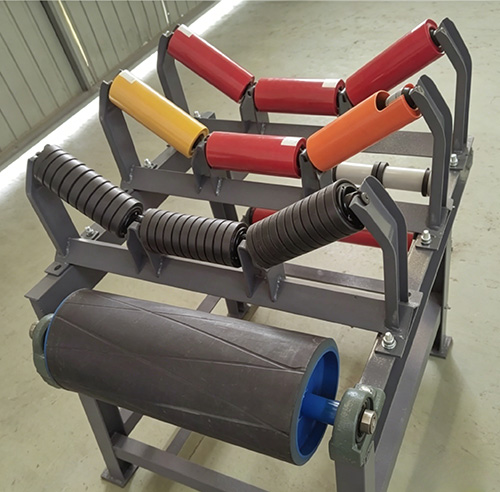
Modern conveyor systems are evolving toward:
Despite technological advancements, parallel idler gears remain a fundamental mechanical solution due to their simplicity and reliability.
Parallel idlers may appear simple, but they play a crucial role in maintaining conveyor stability, especially on the return side. By providing consistent flat support, they reduce vibration, prevent sagging, and improve long-term system efficiency.
When properly installed and integrated with other conveyor components, parallel idlers contribute significantly to smoother, more reliable, and more efficient material handling operations.
What are parallel idlers used for?
They support the return side of a conveyor belt in a flat, stable position.
Where should parallel idler gears be installed?
They are mainly used on return-side conveyor sections and long conveyor systems.
Do parallel idler gears reduce vibration?
Yes, they help stabilize belt movement and reduce return-side vibration.
Are parallel idler gears suitable for all conveyors?
They are commonly used in most conveyor systems, especially on return sides.
How do parallel idler gears differ from troughing idlers?
Parallel idlers support a flat belt, while troughing idlers support loaded belts in a V shape.