Are you ready to customize your product?
Fill in your information and requirements, and we will address your inquiry promptly!


In modern woodworking production, surface finishing quality directly determines product value. Whether you are producing furniture panels, cabinet doors, or engineered wood components, achieving consistent smoothness across different material types is a constant challenge.
This is where a four-wheel sander becomes a game-changing solution.
Unlike traditional sanding systems that rely on single-stage or two-stage processing, a four-wheel sander integrates multiple sanding units into a single continuous workflow. This allows you to complete rough sanding, intermediate leveling, fine sanding, and surface polishing in one pass—significantly improving efficiency while maintaining consistent quality.
In this article, you will explore how a four-wheel sander works, why it is widely used in industrial woodworking, and how it can help you improve production stability and surface finishing quality.

Surface finishing is no longer just about smoothness—it is about consistency, repeatability, and production efficiency.
In traditional setups, operators often rely on multiple separate machines to complete sanding tasks. This leads to:
Industry observations in woodworking production lines show that inefficiencies in sanding processes can significantly slow down overall throughput, especially in high-volume manufacturing environments.
A four-wheel sander addresses these issues by integrating multiple sanding stages into a single automated system.
A four-wheel sander is a multi-roller sanding machine designed to process wood surfaces through sequential sanding stages.
Each wheel performs a specific function:
As the material passes through the machine:
This staged approach ensures that every piece receives consistent finishing quality.
Instead of using multiple machines, you complete the entire sanding process in a single workflow.
Each sanding stage is controlled, reducing variations between operators or batches.
Fewer material handling steps mean faster production cycles.
Automation reduces the need for manual intervention between sanding stages.
Works effectively on hardwood, softwood, engineered panels, and composite surfaces.
| Feature | Four-Wheel Sander | Single/Two-Wheel Systems |
|---|---|---|
| Sanding Stages | 4 integrated stages | 1–2 stages |
| Production Efficiency | High | Medium |
| Surface Consistency | Very high | Variable |
| Labor Requirement | Low | Higher |
| Material Flexibility | Wide range | Limited |
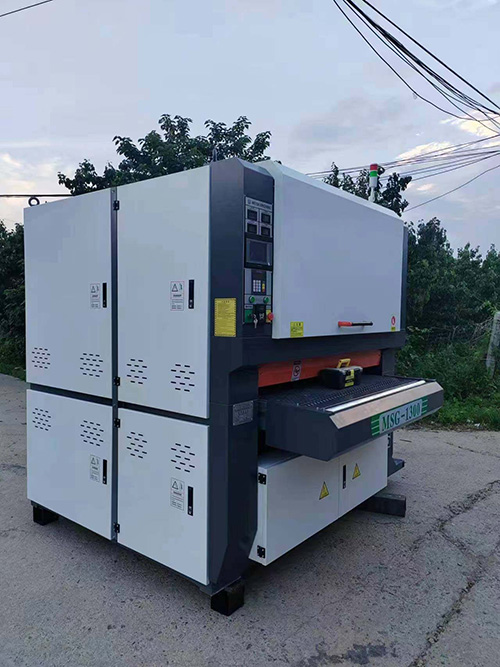
Ideal for cabinet doors, table panels, and decorative wood components.
Ensures uniform thickness and smooth surface preparation.
Provides precise finishing for engineered wood flooring surfaces.
Reduces bottlenecks in sanding-heavy production workflows.
A woodworking production line experienced inconsistent surface quality across batches of engineered wood panels. Operators were using separate sanding machines for each stage, leading to variations in finish quality.
A four-wheel sanding system was introduced to unify the sanding process.
This demonstrates how process integration directly improves manufacturing quality and efficiency.
The performance of a four-wheel sander is based on controlled progressive abrasion:
Combined with variable feed control and pressure adjustment, this ensures predictable and repeatable results.
According to general woodworking machinery principles referenced in technical discussions by organizations such as the CEMA (for material handling systems integration standards) and manufacturing efficiency insights shared on platforms like LinkedIn, process consolidation is one of the key drivers of production optimization.
A four-wheel sander is often integrated into automated production environments:
These integrations help build a continuous, efficient sanding workflow from rough processing to final finishing.
To ensure stable operation:
Proper maintenance ensures consistent finishing quality and extends machine lifespan.
Modern woodworking production is moving toward fully automated finishing lines that combine:
Despite these advancements, the four-wheel sander remains a core technology because it balances efficiency, simplicity, and consistent output quality.
A four-wheel sander is a highly efficient solution for modern woodworking operations that require consistent surface quality and high production output. By combining multiple sanding stages into a single automated system, it reduces labor dependency, improves efficiency, and ensures uniform finishing results across all materials.
For any production environment focused on scalability and precision, this type of sanding system offers a practical and long-term competitive advantage.
What is a four-wheel sander used for?
It is used for multi-stage sanding and surface finishing of wood and composite materials.
What materials can it process?
It can handle hardwood, softwood, MDF, plywood, and engineered panels.
Does it replace multiple sanding machines?
Yes, it integrates multiple sanding stages into a single machine.
Is it suitable for mass production?
Yes, it is designed for high-efficiency industrial woodworking lines.
How does it improve surface quality?
By applying sequential sanding stages with controlled pressure and feed speed.