Are you ready to customize your product?
Fill in your information and requirements, and we will address your inquiry promptly!

In conveyor systems, the return side of the belt is often overlooked. Most operators focus heavily on carrying idlers and drive components, assuming the return section is “low impact.” However, in real industrial environments, the return belt is where many hidden inefficiencies begin—belt misalignment, material buildup, excessive vibration, and even safety risks.
This is exactly where V return idlers become essential.
A V return idler is designed to support the return side of the conveyor belt using a V-shaped roller configuration. This structure helps center the belt, reduces sagging, and improves stability during high-speed or long-distance transport. While it may look like a simple component, its effect on system performance is significant.
In this article, you will explore how V return idlers work, why they are widely used in modern conveyor systems, and how you can optimize your system design using them effectively.

Many engineers initially underestimate the importance of the return side. Since no material is being transported on the return belt, it is often assumed to have minimal impact. However, this assumption leads to some of the most common conveyor failures.
In practice, the return belt is responsible for:
Industry observations show that return-side instability contributes significantly to long-term belt wear and misalignment issues, especially in extended conveyor systems.
A V return idler consists of two rollers arranged in a V shape, forming a trough-like support structure for the return belt.
The working principle is simple but effective:
This passive self-centering mechanism reduces the need for additional alignment devices and improves long-term operational consistency.
The V shape naturally guides the belt toward the center position, reducing sideways drift during operation.
Long conveyor spans often experience belt sagging on the return side. V return idlers help maintain consistent support.
Because alignment issues are reduced, operators spend less time correcting belt position.
A stable return belt reduces the risk of sudden belt movement or structural contact.
| Feature | Flat Return Idler | V Return Idler |
|---|---|---|
| Belt Support | Single point | Dual angled support |
| Belt Tracking | Limited control | Self-centering effect |
| Sag Prevention | Moderate | Strong |
| Stability in Long Conveyors | Lower | Higher |
| Maintenance Demand | Higher | Lower |
Proper placement is critical for maximizing performance.
The longer the system, the more likely the belt is to drift on the return side.
Higher speed increases vibration risk, making stabilization essential.
Even though the return belt is empty, high-load systems still create structural stress.
In real-world installations where perfect alignment is difficult, V-return idlers help compensate for structural variation.
A bulk material handling operation experienced recurring issues on the return side of a 120-meter conveyor system. The belt frequently drifted and contacted structural frames, causing wear and operational interruptions.
The system was upgraded by replacing key return sections with V return idlers.
This case demonstrates how a simple structural modification can resolve persistent operational issues.
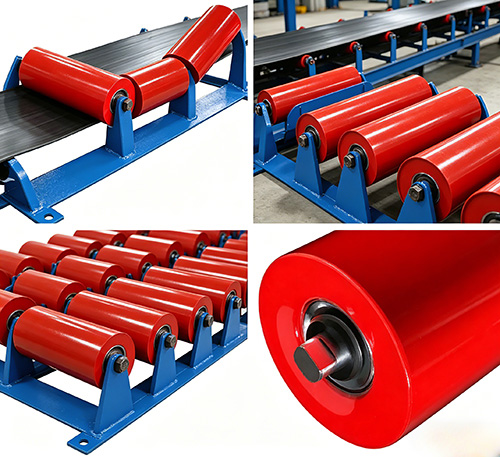
V return idlers help resolve several long-standing conveyor challenges:
These issues are often misdiagnosed as drive system problems when, in reality, they originate in return-side instability.
The effectiveness of V-return idlers is based on basic mechanical equilibrium:
Unlike active control systems, V return idlers operate passively, meaning they require no power or external control input.
This makes them highly reliable and low-maintenance in continuous industrial operations.
Even though V-return idlers are low-maintenance, periodic inspection is essential.
Proper maintenance ensures long-term stability and prevents unexpected downtime.
Engineering discussions on platforms such as LinkedIn often highlight that return side issues are among the most underestimated causes of conveyor inefficiency.
Similarly, material handling guidelines referenced by CEMA emphasize the importance of proper return support design in conveyor system reliability.
Modern conveyor systems are evolving toward smarter and more adaptive designs, including:
Despite these innovations, V-return idlers remain a fundamental mechanical solution due to their simplicity and reliability.
V return idlers play a critical role in improving conveyor system stability by controlling return belt movement, reducing sagging, and enhancing alignment. While often overlooked, they contribute significantly to reducing maintenance costs and improving operational efficiency.
By integrating V return idlers into your conveyor system design, you create a more stable, reliable, and efficient material handling process—especially in long-distance and high-speed applications.
What is a V return idler used for?
It supports and stabilizes the return side of a conveyor belt using a V-shaped roller configuration.
Where should V return idlers be installed?
They are commonly installed in long conveyors, high-speed systems, and return belt sections prone to misalignment.
Do V return idlers reduce maintenance?
Yes, they help reduce alignment-related maintenance by stabilizing belt movement.
Can V return idlers fix severe belt misalignment?
They are most effective for minor to moderate return belt instability, not structural installation errors.
Are V return idlers necessary for all conveyors?
Not always, but they are highly recommended for long-distance or high-speed conveyor systems.