Are you ready to customize your product?
Fill in your information and requirements, and we will address your inquiry promptly!


If you manage or operate a conveyor system long enough, you eventually face a familiar problem: the belt starts drifting to one side, material begins spilling, and the system requires constant manual correction. At first, it looks like a minor mechanical issue. But over time, it becomes clear that belt misalignment is not just a symptom—it is a system-wide inefficiency that increases downtime, accelerates wear, and raises operational costs.
This is exactly where self-aligning idlers change the entire equation.
Unlike standard idlers that only support the belt, self-aligning idlers actively guide and correct belt movement during operation. They work continuously in the background, automatically adjusting to belt deviation and restoring alignment without manual intervention.
In this guide, you will learn how self-aligning idlers work, where they should be installed, how they compare to conventional idler systems, and how real industrial operations use them to improve conveyor stability and reduce long-term maintenance burden.
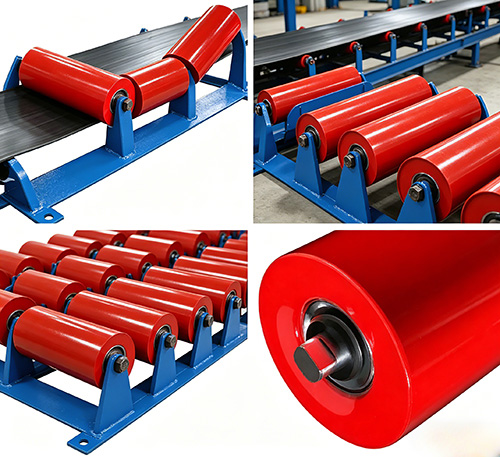
Before discussing solutions, you need to understand the root causes of belt misalignment. In most industrial systems, misalignment is not caused by a single factor but by a combination of mechanical and operational conditions.
When material is not evenly distributed across the belt, one side experiences more tension than the other. This causes the belt to gradually drift toward the lighter side.
Even small deviations in conveyor structure alignment can create progressive tracking errors over long distances.
Worn or unevenly installed idlers create rotational imbalance, which directly affects belt direction.
Dust accumulation, moisture, and temperature changes can all affect friction levels and belt movement behavior.
Industry maintenance reports from bulk material handling systems show that belt misalignment accounts for a significant portion of unplanned conveyor maintenance events, often leading to repeated adjustments if no corrective system is installed.
A self-aligning idler is a specially designed conveyor component that automatically corrects belt deviation by adjusting its angle in response to belt movement.
Instead of remaining fixed, it reacts dynamically:
This self-correcting mechanism eliminates the need for manual realignment in many sections of the conveyor system.
You can view a typical product example here:
Self-Aligning Idler
In modern production environments, efficiency is no longer just about speed—it is about consistency and uptime.
Self-aligning idlers contribute to this in several ways:
In long conveyor systems, especially those exceeding tens or hundreds of meters, even minor misalignment can escalate into major operational inefficiencies. Self-aligning idlers act as a passive correction system that continuously stabilizes performance.
Placement is one of the most important factors in achieving optimal performance. Installing self-aligning idlers in the wrong locations reduces their effectiveness.
This is the most common installation point. The return belt is more prone to lateral movement, making it ideal for correction.
Areas where the belt changes from flat to trough shape often experience tracking instability.
The longer the conveyor, the higher the probability of cumulative misalignment.
Installing self-aligning idlers before material loading helps stabilize belt tracking early in the process.
| Feature | Standard Idler | Self-Aligning Idler |
|---|---|---|
| Belt Tracking Control | None | Automatic correction |
| Maintenance Requirement | Medium to High | Low |
| Misalignment Prevention | Passive | Active |
| Operational Stability | It depends on installation accuracy | Self-adjusting |
| Long-distance suitability | Limited | High |
The working principle is based on mechanical feedback response.
When the belt shifts laterally:
This continuous feedback loop ensures stability without electronic control systems.
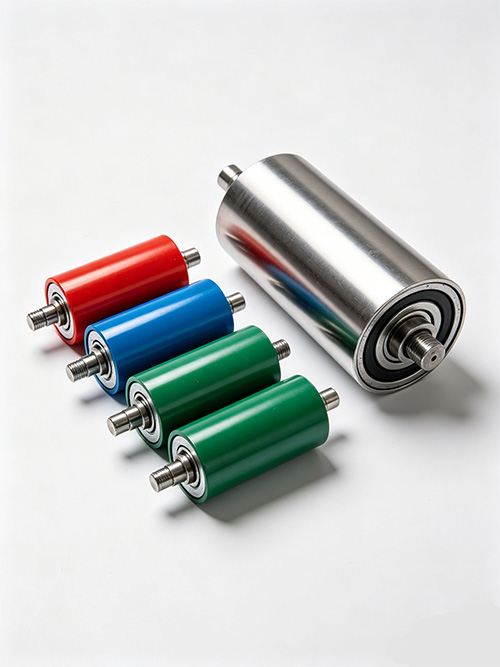
A bulk material handling system used in continuous operation was experiencing frequent belt drift issues. Operators had to manually adjust alignment multiple times per shift, causing downtime and inconsistent material flow.
This demonstrates how mechanical self-correction can replace repeated manual adjustments.
Self-aligning idlers are widely used in industries where conveyor stability is critical. Based on operational observations across bulk material handling systems, their benefits include:
Research published by organizations such as the CEMA highlights that belt tracking systems significantly improve operational reliability when properly integrated into conveyor design.
You can also find general conveyor system principles referenced in engineering documentation such as ISO standards related to material handling systems.
Even though self-aligning idlers are effective, improper use can reduce their performance.
Installing them everywhere does not improve performance. Strategic placement is more effective.
Self-aligning idlers cannot compensate for major structural misalignment.
If material is heavily uneven, mechanical correction alone may not be sufficient.
Even self-aligning systems require inspection for wear and rotation issues.
To ensure stable performance, follow a structured maintenance approach:
Proper maintenance ensures that the self-correcting mechanism remains responsive and accurate.
On professional platforms such as LinkedIn, conveyor engineers frequently emphasize that belt tracking issues are often underestimated during system design. Many discussions highlight that mechanical self-adjustment solutions like self-aligning idlers reduce long-term operational complexity more effectively than repeated manual corrections.
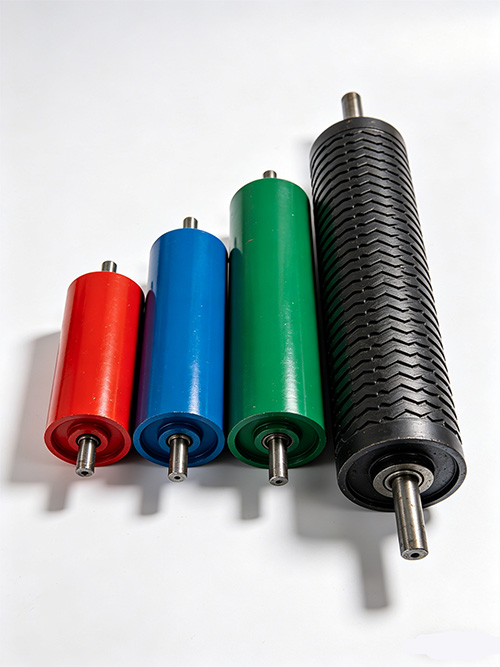
The future of conveyor alignment is moving toward hybrid systems that combine:
While traditional self-aligning idlers remain essential, they are increasingly being integrated into smarter conveyor ecosystems that improve operational visibility and reduce unexpected failures.
Self-aligning idlers play a crucial role in improving conveyor stability by automatically correcting belt deviation and reducing the need for manual adjustments. When properly placed and maintained, they significantly improve system efficiency, reduce wear, and enhance operational consistency.
Instead of treating belt alignment as a recurring problem, integrating self-aligning idlers allows you to shift toward a more stable, self-correcting conveyor system—one that works continuously in the background while your operation focuses on productivity.
What is a self-aligning idler used for?
It is used to automatically correct conveyor belt misalignment during operation.
Where should self-aligning idlers be installed?
They are typically installed in return sections, transition zones, and long conveyor runs.
Do self-aligning idlers replace maintenance?
No, they reduce manual correction but still require periodic inspection.
Can they fix severe belt misalignment?
They are effective for minor to moderate misalignment but not for structural installation errors.
Are self-aligning idlers suitable for all conveyors?
They are best suited for long-distance and continuous-operation conveyor systems.