Are you ready to customize your product?
Fill in your information and requirements, and we will address your inquiry promptly!


If your conveyor system has ever suffered from recurring belt misalignment, uneven material flow, abnormal noise, or rising maintenance costs, the root cause may not be as obvious as you think. In many industrial environments, these issues are often traced back to a component that receives far less attention than it deserves—the carrying idler frame.
While belts, motors, and rollers are frequently discussed, the structural integrity and configuration of carrying idler frames quietly determine whether your entire system operates smoothly or becomes a constant source of downtime. In high-throughput operations, even a minor inefficiency in frame alignment or load distribution can translate into measurable financial loss over time.
This article goes beyond basic explanations. You will learn how carrying idler frames influence conveyor performance at a structural level, how to select the right configuration based on real operating conditions, and how to apply practical strategies that improve efficiency, reduce wear, and extend system lifespan. The goal is not just to inform you—but to give you a clear, actionable framework you can apply directly in your operation.
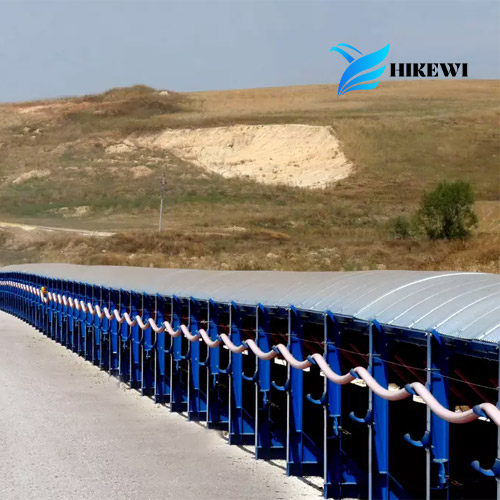
A carrying idler frame is the structural assembly that supports and positions conveyor idlers, ensuring that the conveyor belt maintains its correct shape and alignment during operation. These frames are typically mounted along the length of the conveyor and are designed to hold rollers in a trough configuration.
From a mechanical perspective, the carrying idler frame determines three critical parameters:
Without a properly designed frame, even the highest-quality rollers cannot perform effectively. The frame acts as the reference structure that defines how the belt interacts with the load.
In industrial conveyor systems, especially those handling bulk materials, the carrying idler frame is not just a support component—it is a load-bearing structural element that directly influences system reliability.
To understand the importance of carrying idler frames, you need to look at how forces are distributed in a conveyor system.
When material is loaded onto a conveyor belt, the weight creates a downward force. This force is transferred through the belt to the idlers and then to the frame. If the frame is not rigid or properly aligned, the load distribution becomes uneven.
This leads to several issues:
According to engineering studies in bulk material handling systems, uneven load distribution can increase belt wear rates by up to 35% and reduce conveyor efficiency by 10–15% over time.
A well-designed carrying idler frame ensures that these forces are evenly distributed, maintaining system balance and reducing mechanical strain.
Carrying idler frames are typically fabricated from steel and designed to withstand both static and dynamic loads. The structural design includes:
The geometry determines the trough angle, usually between 20° and 45°, depending on material characteristics. Steeper angles improve material containment but increase stress on the belt edges.
Frames are fixed to the conveyor structure at specific intervals. Proper mounting ensures stability and prevents vibration during operation.
Heavy-duty frames are reinforced to handle higher loads and impact forces, particularly in bulk material applications.
In harsh environments, frames are often treated with protective coatings to prevent corrosion and extend service life.
Different applications require different frame configurations. Understanding these types helps you match the right solution to your system.
These frames maintain a constant trough angle and are suitable for stable, predictable operations. They are widely used due to their simplicity and reliability.
These frames allow operators to adjust the trough angle and alignment. They are particularly useful when handling multiple material types or when system optimization is required.
Designed for high-load applications, these frames feature reinforced construction to handle extreme weight and impact.
These frames automatically correct belt misalignment. They are essential in long conveyor systems where manual adjustments are impractical.
| Frame Type | Load Capacity | Flexibility | Maintenance Level | Best Application |
|---|---|---|---|---|
| Fixed Frame | Medium | Low | Low | Standard systems |
| Adjustable Frame | Medium | High | Medium | Variable loads |
| Heavy-Duty Frame | High | Low | Medium | Bulk handling |
| Self-Aligning Frame | Medium | High | Medium | Long conveyors |
In a panel processing facility, operators experienced frequent belt drift and inconsistent surface contact during material transport. The issue led to increased maintenance and reduced production efficiency.
This case highlights how structural improvements at the frame level can deliver measurable operational benefits.

When selecting carrying idler frames, you should evaluate the following parameters in detail:
Calculate the expected load per meter of the conveyor and ensure the frame can handle peak conditions.
In loading zones, consider the impact force of falling materials and select reinforced frames accordingly.
For long conveyors, prioritize self-aligning frames to minimize manual correction.
In environments with dust, moisture, or chemicals, choose corrosion-resistant materials and coatings.
Cause: Uneven frame installation or lack of alignment control
Solution: Use self-aligning frames and ensure precise installation
Cause: Uneven load distribution
Solution: Optimize frame spacing and trough angle
Cause: Increased rolling resistance
Solution: Improve alignment and reduce friction through better frame design
A structured maintenance plan can significantly extend the lifespan of your frames.
Check for deformation, loose bolts, and alignment issues.
Remove debris buildup that may affect roller movement.
Inspect welds and support structures for signs of fatigue.
Replace damaged frames proactively to avoid cascading failures.
The efficiency of a conveyor system is directly linked to how smoothly the belt operates. Carrying idler frames influence:
Studies in material handling engineering indicate that optimized conveyor support structures can improve overall system efficiency by up to 15%, depending on operating conditions.
Before selecting a carrying idler frame, ask yourself:
Carrying idler frames are a foundational component of any conveyor system. Their design, selection, and maintenance directly impact system stability, efficiency, and longevity.
By focusing on structural integrity, proper alignment, and application-specific design, you can transform your conveyor system from a source of recurring issues into a reliable, high-performance operation.
What is the main purpose of a carrying idler frame?
It supports and aligns conveyor idlers, ensuring stable belt operation and proper load distribution.
How do carrying idler frames affect conveyor performance?
They influence alignment, load distribution, and overall system efficiency.
Can carrying idler frames reduce maintenance costs?
Yes, proper selection and installation reduce wear and minimize maintenance frequency.
How often should frames be inspected?
Regular inspections should be part of routine maintenance, especially in high-load systems.
What materials are used for carrying idler frames?
They are typically made from steel with protective coatings for durability.