Are you ready to customize your product?
Fill in your information and requirements, and we will address your inquiry promptly!


If you are running a warehouse, production line, or distribution center, you already know that depalletizing is rarely the part of the operation anyone wants to talk about. It’s repetitive, physically demanding, error-prone, and increasingly difficult to staff. Yet it sits at a critical junction between inbound logistics and downstream processing. When depalletizing slows down, everything behind it suffers.
This is exactly why more operations are now evaluating an automatic depalletizer—not as a futuristic upgrade, but as a practical response to real-world constraints: labor shortages, rising safety standards, mixed pallet formats, and pressure to increase throughput without expanding floor space.
This article is written for you if you are actively looking for ways to modernize unloading operations or if manual depalletizing is becoming a bottleneck you can no longer ignore. Instead of generic descriptions, you will find operational logic, real application scenarios, and decision-level guidance that helps you determine whether an automatic depalletizer actually fits your environment.
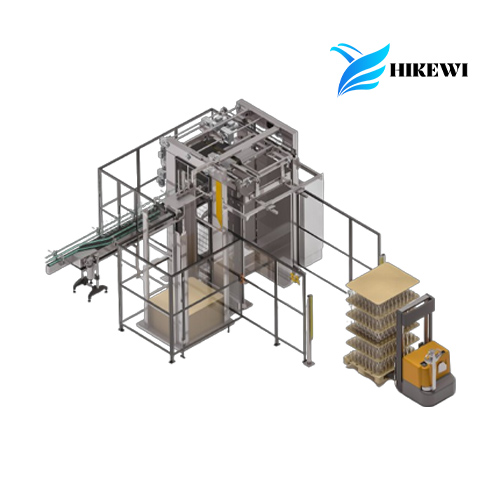
At its core, an automatic depalletizer replaces manual unloading of goods from pallets with a robotic system that identifies, grips, and removes products layer by layer or item by item. But from your point of view, its real function is broader:
Modern systems no longer assume uniform pallets. Instead, they are designed to deal with mixed pallet configurations, irregular stacking, and variable packaging—conditions that are increasingly common in real logistics environments.
Several industry forces are converging, making automation at the depalletizing stage more urgent than before:
If your inbound pallets include mixed cartons, bulk bags, or non-uniform loads, the case for automation becomes even stronger.
Older depalletizing systems relied on predefined patterns and rigid programming. That approach works only when pallet layouts never change. In reality, your pallets change all the time.
Modern automatic depalletizers integrate 3D vision systems and AI-based algorithms, allowing the system to:
This shift from static logic to adaptive intelligence is what makes today’s systems viable for complex, high-mix operations.
One of the most critical components in an automatic depalletizer is its vision system. Without accurate perception, automation fails.
Advanced systems now rely on 3D point cloud processing, enabling the robot to build a depth-based model of the pallet surface. With a processing speed of ≤1.5 seconds per frame and positioning accuracy of ±0.1 mm, the system can reliably locate cartons, bags, or irregular objects even when pallets are uneven or partially damaged.
From an operational standpoint, this means:
Mixed pallet depalletizing used to require manual intervention or frequent reprogramming. Today, AI-supported systems can identify different carton sizes, orientations, and stacking styles automatically.
For you, this eliminates one of the biggest hidden costs of automation: engineering time. Instead of stopping the line every time pallet formats change, the system adapts on its own.
In practice, this allows depalletizing speeds of ≥1500 cartons per hour, even under mixed-load conditions.
For carton depalletizing, vacuum suction is still one of the most reliable gripping methods—but only when controlled precisely.
A well-designed system offers vacuum suction force ranging from 50 to 200 Newtons, adjustable in real time based on carton weight, surface condition, and stacking pressure.
This matters because:
If your cartons include different materials, coatings, or weights, adaptive vacuum control directly affects product quality and uptime.
Not all depalletizing tasks involve cartons. Many industries handle bulk bag materials, which introduce a different challenge entirely.
Automatic depalletizers designed for bulk bags use mechanical gripping systems with adjustable gripping force from 10 to 80 kg, allowing the system to adapt to bag weight and material flexibility.
This adaptive grip prevents tearing, deformation, or internal product shift—issues that are common when bulk bags are handled manually or with fixed-force equipment.
Depalletizing speed is not just about how fast the robot moves. It’s about how efficiently it moves.
Modern systems use dynamic path optimization, recalculating motion trajectories in real time based on:
For you, this translates into shorter cycle times, smoother motion, and reduced mechanical wear—benefits that accumulate over thousands of cycles per day.
Depalletizing is a high-risk operation when done manually. Automation reduces risk, but only if safety is built into the system itself.
Advanced automatic depalletizers incorporate 3D obstacle avoidance systems with detection ranges from 0.3 to 3 meters, continuously monitoring the working envelope.
Additionally, overload protection with ±10% thresholds ensures that abnormal loads or collisions trigger immediate system responses.
From a compliance and insurance standpoint, this significantly reduces exposure to workplace incidents.
Scenario:
A mid-sized food packaging plant received inbound pallets with mixed carton sizes, inconsistent stacking, and frequent pallet damage.
Challenge:
Manual depalletizing limited throughput and caused frequent carton deformation.
Solution:
An automatic depalletizer with 3D vision and AI recognition was installed upstream of the packaging line.
Results:
| Metric | Before | After |
|---|---|---|
| Throughput | 800 cartons/hour | 1500+ cartons/hour |
| Labor per shift | 4 workers | 1 supervisor |
| Carton damage rate | ~2.5% | <0.3% |
| Unplanned stops | Frequent | Rare |
Scenario:
Bulk chemical bags were manually unloaded, creating safety risks and inconsistent flow to downstream processing.
Solution:
A depalletizer with adaptive gripping force (10–80 kg) and vision-based positioning.
Results:
| Metric | Improvement |
|---|---|
| Safety incidents | Reduced to zero |
| Bag damage | Eliminated |
| Labor requirement | –70% |
| Line stability | Significantly improved |
Ask yourself these questions:
If you answered “yes” to two or more, automation is likely not optional—it’s inevitable.
A depalletizer does not work in isolation. It must integrate with:
Early integration planning avoids expensive retrofits later.
Avoiding these mistakes saves time, money, and frustration.
An automatic depalletizer is no longer just a labor-saving device. When intelligently designed and properly integrated, it becomes a stabilizing force across your entire operation—improving safety, consistency, and throughput at the point where everything begins.
If depalletizing is currently a hidden constraint in your workflow, addressing it may unlock performance gains far beyond the unloading zone itself.
Can an automatic depalletizer handle damaged pallets?
Yes, modern vision systems can compensate for moderate irregularities.
Is mixed pallet handling reliable?
With AI and 3D vision, reliability is high when properly configured.
How much space is required?
Footprint varies, but systems are designed for compact integration.
What maintenance is required?
Routine inspection of grippers, sensors, and safety systems.
Is automation suitable for small operations?
Yes, if depalletizing is a bottleneck or safety concern.